



Salary Benchmarking Services in Malaysia
Are you paying your people enough to keep them? Are you offering competitive salaries to attract the talent you need? Without current, reliable market data, these questions are guesswork, and guesswork costs you either overpaying or losing your best people to competitors who pay better.
6HRS salary benchmarking provides Malaysian businesses with accurate, current compensation data across industries, functions, and experience levels, giving you the foundation to make pay decisions you can justify and defend.
What Is Salary Benchmarking?
Salary benchmarking is the process of comparing your employees' compensation against current market rates for equivalent roles in your industry and geography.
It answers questions like: Are we paying our Production Supervisor 15% below market? Is our Sales Manager package competitive with FMCG peers? What salary range should we advertise for a Finance Executive in Klang Valley?
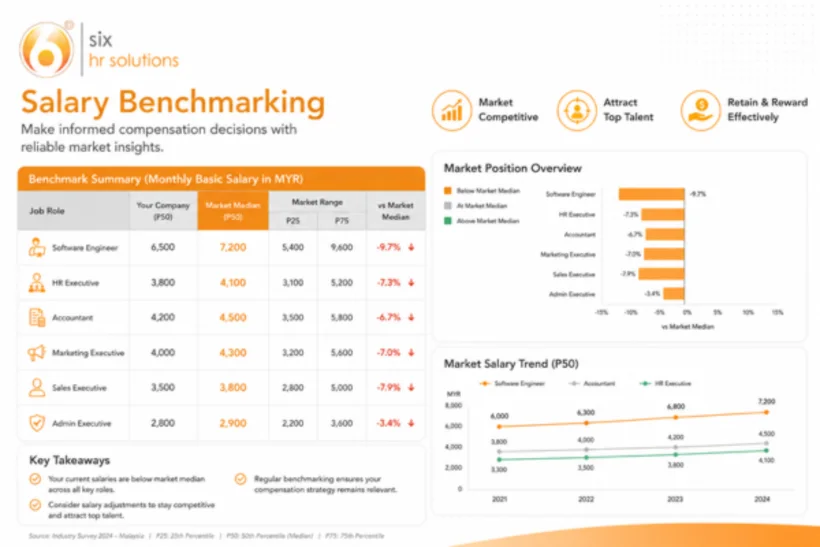
What's Included in a 6HRS Salary Benchmarking Report
- Role-by-role market comparison, your current salaries mapped against market percentiles (P25, P50, P75)
- Industry-specific data, compensation benchmarks calibrated for your sector
- Geographic adjustment, Klang Valley, Penang, Johor, and national comparisons
- Experience banding, junior, mid, senior, and leadership benchmarks per function
- Benefits benchmarking, allowances, bonuses, medical, and non-cash benefits
- Pay gap identification, which roles are at risk of turnover due to below-market compensation
- Salary band recommendations, structured pay bands for each job family and level
Industries Covered
Manufacturing · FMCG · Retail · Technology · Financial Services · Logistics & Supply Chain · Business Services
Frequently Asked Questions
What is salary benchmarking in Malaysia?
Salary benchmarking in Malaysia involves comparing an organisation's salary structures against current market compensation data for equivalent roles across the same industry and geography. It is used to set competitive pay, reduce turnover, and build defensible salary bands.
How often should a Malaysian company do salary benchmarking?
Best practice is annually, especially given minimum wage increases, market movement in key talent pools, and cost-of-living adjustments. Companies experiencing high voluntary turnover should benchmark immediately.
How is this different from a salary survey?
A salary survey provides aggregated market data from multiple organisations. Salary benchmarking applies that data specifically to your organisation's roles, structure, and pay bands, translating market data into actionable decisions for your business.
Know what your team is worth, and what the market pays.
Request a salary benchmarking report tailored to your industry and roles.
Request a Report → No commitment. No hard sell. Just honest HR advice.